Mar. 27th 2026
As the "hybrid offspring" of plastics and rubber, POE (Polyolefin Elastomer) has swept through industries like photovoltaics, automotive, and packaging thanks to its superior toughness and weather resistance. However, are you often confused by terms like "4C/8C" or "Vinyl/Allyl" when selecting grades?
In fact, everything boils down to just two dimensions: the carbon count of the comonomer and the backbone type. Today, we’ll clarify the differences, properties, and applications in one go—making your selection process a perfect match!
1. Start with the Core: What Are 4C/8C and Vinyl/Allyl?
(1) C4 vs. C8: It's All About the Comonomer's Carbon Chain Length
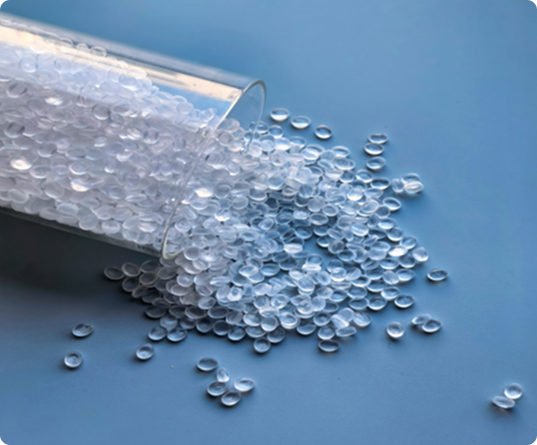
The core of POE lies in the copolymerization of "ethylene and α-olefin." The terms "C4" and "C8" refer to the number of carbon atoms in the α-olefin comonomer. This classification aligns with industry standards (referencing technical manuals from Dow and LG).
C4 POE: Copolymerized from ethylene and 1-butene (EBR). With a shorter carbon chain (4 Cs), it serves as the entry-level, cost-effective choice.
C8 POE: Copolymerized from ethylene and 1-octene (EOR). Featuring a longer carbon chain (8 Cs), it sets the benchmark for high-end performance.
Cool fact: There's also C6 POE (ethylene + 1-hexene), which focuses on heat resistance (melting temperature of 60–70°C). Though niche, it's ideal for high-temperature cable applications—represented by products like ExxonMobil Exact 6102.
(2) Ethylene-based vs. Propylene-based: It's About the "Backbone" Monomer
Ethylene-based POE (Narrow Sense)
The backbone is primarily ethylene, copolymerized with α-olefins (butene/octene). This category dominates over 95% of the global market. Representative products include Dow's Engage and LG's Lucene series.
Propylene-based POE (Broad Sense Elastomer)
The backbone is primarily propylene, or involves propylene copolymerized with α-olefins (e.g., ExxonMobil Vistamaxx). This represents a high-end, specialized category focused on precision applications, featuring higher technological barriers.
2. POE Classification & Specifications (Data sourced from official manufacturer datasheets)
|
Comparison Dimension |
4C Ethylene-based POE (EBR) |
8C Ethylene-based POE (EOR) |
Propylene-based POE (Elastomer) |
Core Advantage Label |
|
Flexibility / Elasticity |
Medium (Shore A Hardness 48–66) |
Excellent (Shore A Hardness 45–60) |
Excellent (Shore A Hardness 30–55) |
8C >Propylene >4C |
|
Low Temp Impact Resistance |
-23°C Impact Strength ≥12kJ/m2(LG LC565 Test) |
-40°C Impact Strength ≥15kJ/m2(Dow 7447 Test) |
-50°C Impact Strength ≥18kJ/m2(ExxonMobil 6202 Test) |
Propylene >8C >4C |
|
Heat Resistance |
Melting Temp 47–56°C (Letian LEB 6210) |
Melting Temp 59–77°C (Dow 8100) |
Melting Temp 65–105°C (ExxonMobil Vistamaxx) |
Propylene >8C >4C |
|
Processing Flowability |
High MFR1.2−30g/10min |
Medium Medium MFR0.5−5.0g/10min |
Low – Medium MFR0.5−3.0g/10min |
4C >8C >Propylene |
|
Compatibility |
Compatible with PP/PE Blending |
Compatible with PP/EVA/EPDM Blending |
Compatible with PP / Engineering Plastic Blending |
8C >4C >Propylene |
|
Cost |
Low (12–18 RMB/kg) |
Medium (18–25 RMB/kg) |
High (25–35 RMB/kg) |
4C <8C |
|
Representative Products |
Letian LEB 6210,LG LC565,Dow 7447 |
Dow Engage 8100,LG LF575,ExxonMobil 9061 |
ExxonMobil Vistamaxx 6202/3980FL |
– |
Data Sources: Dow Chemical ENGAGE™ Series Product Manuals, LG Lucene Technical Data Sheets (TDS), and ExxonMobil Exact™/Vistamaxx™ Product Specifications.
03 Perfect Applications: Choose Right, No Waste (with Authoritative Case Studies)
(1)4-Carbon Ethylene-based POE (EBR): The Cost-Performance Choice
Core Scenarios & Applications: General PP/PE Modification: (Appliance Housings, Toys),Low-end Foam Footwear Materials,Wire & Cable Sheathing,Strapping & Packaging Films
Typical Usage: Add 10%-20% in PP blending (e.g., add 15% LG LC565 to enhance impact resistance); substitute 30%-50% of EVA in foam footwear formulations to reduce costs by over 30%.
Advantages: Low processing temperature (160-200℃), excellent flowability (MFR up to 30g/10min), suitable for high-speed mass production, and meets general compounding requirements.
(2)8-Carbon Ethylene-based POE (EOR): The Performance All-Rounder
Core Application Scenarios: Photovoltaic encapsulation films (first choice for N-type modules), high-end automotive parts (bumpers, battery pack seals), and premium foam materials.
Typical Usage: For PV encapsulation films, use LG LF575/LF675 blended with EVA at a ratio of 5-10:85-95 (referencing anti-PID film patent formulas), ensuring a weathering lifespan exceeding 25 years; for automotive bumpers, use Dow Engage 8100, adding 15%-25% to improve low-temperature impact strength by 30%.
Advantages: High light transmittance (≥93%), anti-PID effect (volume resistivity ≥10¹⁴Ω・cm), excellent stiffness-toughness balance, and certified by leading photovoltaic enterprises.
3. Propylene-Based POE (Elastomer): Premium Custom Grade
Core Application Scenarios: Medical-grade products (IV tubes, seals), precision electronic components, and premium automotive interiors (soft dashboards).
Typical Usage: For medical products, use ExxonMobil Vistamaxx 3980FL (FDA certified) for high purity and low odor; in electronic components, blend in 5%-10% to enhance flexibility without compromising stiffness.
Advantages: Low glass transition temperature (-58℃), excellent chemical resistance, and low volatile content (≤0.1%), meeting the stringent requirements of precision applications.
04 Practical Usage Guide: Processing & Material Selection (Avoiding Pitfalls) (Parameters are for reference only, based on manufacturer recommendations)
1. Key Processing Parameters (General Range)
|
Processing Method |
Barrel Temperature (°C) |
Mold Temperature (°C) |
Blending Ratio Recommendation |
|
Injection Molding |
180-230 |
20-40 |
Modification addition 5%-25% |
|
Extrusion Molding (Film) |
160-200 |
- |
Pure POE or blending 30%-50% |
|
Foaming Molding |
170-210 |
30-50 |
Formula proportion 40%-80% |
Note: The processing temperature for 4-carbon POE can be 10-20℃ lower (e.g., Lotte LEB 6210 recommended at 160-190℃); for propylene-based POE, increase by 20-30℃ (e.g., Vistamaxx 6202 recommended at 200-240℃) to avoid compatibility issues.
2.Three-Step Selection Method (Directly usable for beginners)
Prioritize by Requirement: For high-end performance (photovoltaics/automotive), select 8-carbon ethylene; for cost-sensitive (general modification), select 4-carbon; for medical/precision, select propenyl.
Check Processing Conditions: For high-speed mass production, select 4-carbon (high fluidity); for low-temperature conditions, select 8-carbon/propenyl (low-temperature resistance).
Verify Certification Requirements: For food/medical applications, select grades compliant with FDA certification (e.g., LG LC170, ExxonMobil Exact 0201).
2. Common Pitfalls to Avoid (Based on Industry Application Feedback)
4 Carbon POE Replacing 8 Carbon for Photovoltaic Encapsulants: Insufficient Aging Resistance (Yellowing Index > 3 after 1000h of Accelerated Aging Test), Prone to Yellowing and Cracking
Propenyl POE Blended in Large Quantities with PP: Poor Compatibility, Requires Addition of 5%-10% Compatibilizer e.g.,POE−g−MAH
Processing Temperature Exceeding 250°C: POE is Prone to Degradation (Molecular Weight Decrease > 15%), Affecting Toughness and Service Life
05 Mainstream POE Common Grades Summary (Classified by Type)
1. 4-Carbon Ethylene-based POE (EBR)
Dow: 7256, 7270, 7367, 7447, 7457, 7467
LG Chem: LC170, LC175, LC565, LC670
Lotte Chemical: LEB 6210, LEB 6300
2.8-Carbon Ethylene-based POE (EOR)
Dow: 8003, 8100, 8107, 8130, 8150, 8180, 8200, 8400, 8401, 8658 (Photovoltaic Grade)
LG Chem: LF575, LF675, LF100
ExxonMobil: Exact 9061, 9071, 9371,4053
2. Propylene-based POE (Elastomer)
ExxonMobil: Vistamaxx 6202, 3980FL, 2330, 3020FL
Mitsui Chemicals: Tafmer XR Series, XM Series
Note: All grades are sourced from official corporate product catalogs, covering over 90% of mainstream application scenarios.
06 Final Summary
4-Carbon = Cost-Performance, 8-Carbon = High Performance, Propylene-based = Premium Customization
Ethylene-based POE covers 95% of general applications, while Propylene-based focuses on niche premium markets.
Core Selection Criteria: Determine performance requirements first, then review processing conditions, and finally verify certifications.
· · ·END· · ·
This site contains reprinted material intended to share information. Reprinting does not imply endorsement of views or authenticity. For content, copyright, or other issues, please contact us within 30 days for prompt removal.
Previous: none
Next: none
Latest Articles
Mar. 27th 2026
Mar. 27th 2026
Mar. 27th 2026

